Tiger Milk Mushroom Edible and Medicinal Fungi Now Have “Identity Cards” Hainan’s Rare Fungi
Customized quality standards for the elusive tiger milk mushroom(Lignosus rhinocerus 虎乳靈芝/虎乳芝) have been established, Tiger Milk Mushroom Edible and Medicinal Fungi Now Have “Identity Cards” Hainan’s Rare Fungi.
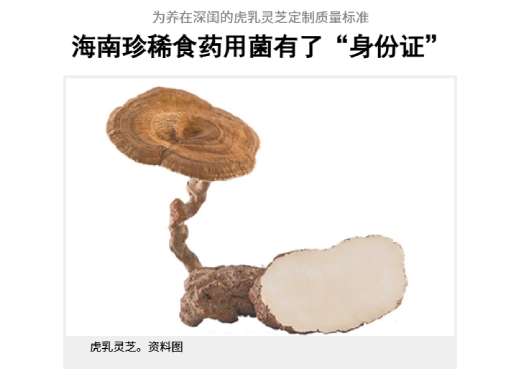
On October 22, World Traditional Medicine Day, good news arrived from the tropical rainforests of central Hainan Island: The Tiger Milk Mushroom, a rare edible and medicinal fungus once marginalized in the market due to the lack of statutory standards, has now successfully obtained a medicinal material quality standard issued by the Hainan Provincial Drug Administration. This achievement stems from the scientific research efforts of Liu Yangyang’s team at the Hainan Branch of the Institute of Medicinal Plant Development, Chinese Academy of Medical Sciences. This new “identity document” not only resolves the long-standing industrial challenges facing the Tiger Milk Mushroom but also highlights the profound significance of modern technology in empowering the development of traditional medicines. It opens up vast opportunities for this tropical treasure within the pharmaceutical industry.
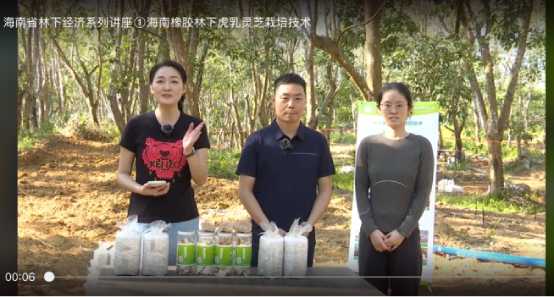
At dawn in Qingsong Township, Baisha Li Autonomous County, mist swirls through the rubber plantations. Workers from Baisha Lishu Biotechnology Co., Ltd. are harvesting ripe Tiger Milk Mushrooms. “Thanks to Xu Lin, the provincial science and technology envoy and edible and medicinal fungi expert from the Institute of Environmental and Plant Sciences at the Tropical Crops Research Institute, we were able to achieve large-scale cultivation of Tiger Milk Mushrooms under rubber trees. He was the first to discover Tiger Milk Mushroom resources in Hainan’s tropical rainforests, successfully completing the technical breakthrough from wild domestication to under-forest cultivation, and then introducing it to Baisha,” Lin Juefeng, the company’s director, held a cluster of mushroom spawn in his hands, his words intertwined with gratitude and resignation. “However, due to the lack of established standards for food and medicinal use, our high-quality Tiger Milk Mushrooms can only be sold as primary agricultural products. We cannot sell them to pharmaceutical companies, nor can we develop them into food products. This significantly reduces the industry’s value. We also worry that even with high yields, market sales may not keep pace.”
The Hainan Provincial Plan for High-Quality Development of Understory Economy (2024–2030), issued in May 2024, explicitly calls for strengthening technological support and encouraging the “enterprise-plus” model to develop understory economy. Today, the scale of Tiger Milk Mushroom cultivation under rubber trees across the province has exceeded 10,000 mu, generating an economic output of nearly 200 million yuan. It has become one of the industries driving rural revitalization in areas like Baisha and Wuzhishan. However, the lack of standards remains a persistent challenge hindering industrial upgrading, leading to the awkward situation of “having production but no export.” This is also a common dilemma faced by the entire Tiger Milk Mushroom industry in Hainan.
The breakthrough came from a pivotal scientific advancement. A research team led by Dr. Liu Yangyang at the Hainan Branch of the Institute of Medicinal Plant Development, Chinese Academy of Medical Sciences, spearheaded the development of the “Quality Standards for Tiger Milk Mushroom Herbal Materials and Slices,” filling a gap in China’s regulatory framework for this field.
“Standards are the ‘identity card’ of an industry,” explained Liu Yangyang. “With these standards in place, slice manufacturers can standardize production, hospitals can apply it clinically, and subsequent development of medical institution preparations and innovative drugs becomes possible. As a rare edible and medicinal fungus, we are also actively collaborating with various parties to advance the formulation of Tiger Milk Mushroom food safety standards and promote its food development, hoping more people can enjoy Tiger Milk Mushroom.”
This research builds upon the achievements of the project “Development and Application of Quality Evaluation Techniques and Standards for 39 Hainan Medicinal Herbs,” for which Liu Yangyang’s team received the Second Prize of the 2022 Hainan Provincial Science and Technology Progress Award. The team’s established model for transforming scientific research outcomes—“resource exploration → standard creation → industrial application → clinical translation”—has become a benchmark supporting the high-quality development of Hainan’s traditional Chinese medicine industry.
Following the standard’s release, market response was immediate. Wu Weiyan, Vice President of Chengmai County Hospital of Traditional Chinese Medicine, stated: “Tiger Milk Mushroom possesses cough-suppressing, asthma-relieving, spleen-strengthening, and dampness-resolving properties. In Hainan and Guangdong folk medicine, it is commonly used in soups and infusions.” Upon seeing the Hainan Provincial Drug Administration release the Tiger Milk Mushroom standard, we immediately procured the prepared slices from traditional Chinese medicine manufacturers for patient use.“ This marked the key transition of Tiger Milk Mushroom from a folk ”local specialty” to a clinical pharmaceutical.
The success of Tiger Milk Mushroom is not an isolated case. In 2023, Liu Yangyang’s team established quality standards for the medicinal materials and processed slices of partridge tea, a beverage with nearly a millennium of consumption history in our province. This initiative propelled this distinctive “folk herbal tea” into use at traditional Chinese medicine hospitals and facilitated its development into medical institution preparations, laying the industrial foundation for the in-depth development of partridge tea as a dual-purpose medicinal and food resource. The research experience with partridge tea provided a successful model for Tiger Milk Mushroom. This exemplifies the value of Liu Yangyang’s team in uncovering Hainan’s distinctive medicinal herbs and conducting systematic quality research to support the industrialization of Hainan’s traditional Chinese medicine sector. Whether for partridge tea or Tiger Milk Mushroom, standardization has granted these “hidden gems” of unique medicinal resources market-recognized status.
From rainforest to farmland, from laboratory to pharmacy, the Tiger Milk Mushroom’s journey from obscurity to prominence exemplifies Hainan’s dynamic integration of ecological advantages, scientific innovation, and industrial development. With the implementation of standards, this research-driven industrial chain is now extending beneath rubber plantations, injecting fresh vitality into rural revitalization.
Hainan Daily All-Media Reporter Ma Ke
source: Hainandaily chinanews 白沙黎族自治县人民政府
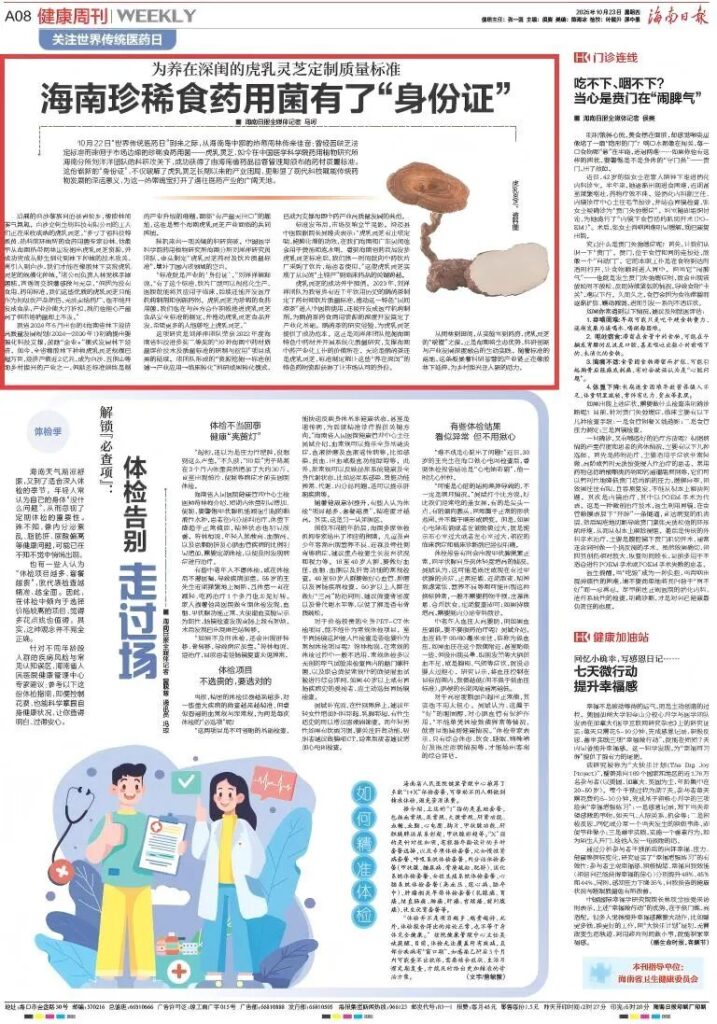
中文新聞全文
海南珍稀食藥用菌有了“身份證” 為養在深閨的虎乳靈芝定製質量標準
■海南日報全媒體記者 馬珂
10月22日“世界傳統醫藥日”到來之際,從海南島中部的熱帶雨林傳來佳音:曾經因缺乏法定標準而徘徊於市場邊緣的珍稀食藥用菌——虎乳靈芝,如今在中國醫學科學院藥用植物研究所海南分所劉洋洋團隊的科研攻關下,成功獲得了由海南省藥品監督管理局頒布的藥材質量標準。這份嶄新的“身份證”,不僅破解了虎乳靈芝長期以來的產業困局,更彰顯了現代科技賦能傳統藥物發展的深遠意義,為這一熱帶瑰寶打開了通往醫藥產業的廣闊天地。
虎乳靈芝
清晨的白沙黎族自治縣青鬆鄉,橡膠林間霧氣氤氳。白沙立樹生物科技有限公司的工人們正在采收成熟的虎乳靈芝。“多虧了省科技特派員、熱科院環植所的食藥用菌專家徐林,他最早從海南熱帶雨林裏發掘出虎乳靈芝資源,並成功完成從野生馴化到林下種植的技術攻關,再引入到白沙,我們才能在橡膠林下實現虎乳靈芝的規模化種植。”該公司負責人林覺楓手捧菌核,言語間交織著感激與無奈,“但因為沒有食用、藥用標準,我們這些優質的虎乳靈芝隻能作為初級農產品銷售,無法賣給藥廠,也不能開發成食品,產業價值大打折扣,我們也擔心產量高了但市場銷量卻上不去。”
我省2024年5月出台的《海南省林下經濟高質量發展規劃(2024—2030年)》明確提出要強化科技支撐,鼓勵“企業+”模式發展林下經濟。如今,全省橡膠林下種植虎乳靈芝規模已超萬畝,經濟產值近2億元,成為白沙、五指山等地鄉村振興的產業之一,但缺乏標準始終是製約產業升級的難題,麵臨“有產量無出口”的尷尬,這也是整個海南虎乳靈芝產業麵臨的共同困境。
轉機來自一項關鍵的科研突破。中國醫學科學院藥用植物研究所海南分所劉洋洋研究員團隊,牽頭製定“虎乳靈芝藥材及飲片質量標準”,填補了國內該領域的空白。
“標準就是產業的‘身份證’。”劉洋洋解釋說,“有了這個標準,飲片廠就可以規範化生產,醫院就能將其應用於臨床,後續還能開發醫療機構製劑和創新藥物。虎乳靈芝為珍稀的食藥用菌,我們也在與各方合作積極推進虎乳靈芝食品安全標準的製定,並推動虎乳靈芝食品開發,希望更多的人能夠吃上虎乳靈芝。”
這項研究是劉洋洋團隊榮獲2022年度海南省科技進步獎二等獎的“39種海南中藥材質量評價技術及質量標準的研製與應用”項目成果的延續。該團隊形成的“資源挖掘→標準創建→產業應用→臨床轉化”科研成果轉化模式,已成為支撐海南中藥產業高質量發展的典範。
標準發布後,市場反響立竿見影。澄邁縣中醫院副院長吳維炎表示:“虎乳靈芝有止咳定喘、健脾化濕的功效,在我們海南和廣東民間也會用於煲湯和泡水喝。看到海南省藥監局發步虎乳靈芝標準後,我們第一時間就向中藥飲片廠采購了飲片,給患者使用。”這使虎乳靈芝實現了從民間“土特產”到臨床藥品的關鍵跨越。
虎乳靈芝的成功並非孤例。2023年,劉洋洋團隊為我省具有近千年飲用曆史的鷓鴣茶製定了藥材和飲片質量標準,推動這一特色“民間涼茶”進入中醫院使用,還被開發成醫療機構製劑,為鷓鴣茶藥食兩用資源的深度開發奠定了產業化基礎。鷓鴣茶的研究經驗,為虎乳靈芝提供了成功範本。這正是劉洋洋團隊挖掘海南特色中藥材並開展係統化質量研究,支撐海南中藥產業化工作的價值所在。無論是鷓鴣茶還是虎乳靈芝,標準製定都讓這些“養在深閨”的特色藥物資源獲得了讓市場認可的身份。
從雨林到田間,從實驗室到藥房,虎乳靈芝的“破壁”之旅,正是海南將生態優勢、科研創新與產業發展深度融合的生動實踐。隨著標準的落地,這條凝聚著科研智慧的產業鏈正在橡膠林下延伸,為鄉村振興注入新的活力。

2 Comments