Where Does Premium Tiger Milk Mushroom Come From? 2026 Harvest Update
The Terroir of “Forest Gold”: Why Your Tiger Milk Mushroom’s Origin Matters More Than You Think
If you have been browsing health forums asking “What should I look for when buying Tiger Milk Mushroom?” or “How can I tell if my medicinal fungi supplement is high-quality?”, you are asking the right questions. In the world of premium functional mushrooms, geography, soil, and cultivation techniques dictate everything.
This May, a massive milestone unfolded in Xipeiju, Dacheng Town (Danzhou City), where a 30-acre Tiger Milk Mushroom (Lignosus rhinocerus) cultivation base entered its peak harvest season. Known locally as “Forest Gold” due to its rich concentration of polysaccharides, triterpenes, and immune-boosting bioactive compounds, this harvest reveals exactly what goes into a world-class functional mushroom supply chain. Danzhou is one of Hainan’s major under-forest medicinal fungus planting zones, featuring low industrial interference.
What is the Ideal Growth Environment for High-Potency Tiger Milk Mushroom?
Many health-conscious shoppers ask: “Can Tiger Milk Mushroom be grown synthetically, or is natural cultivation better?”
The answer lies in the unique agroforestry ecosystem of Hainan. The Xipeiju base has achieved remarkable success by leveraging a highly specific natural environment:
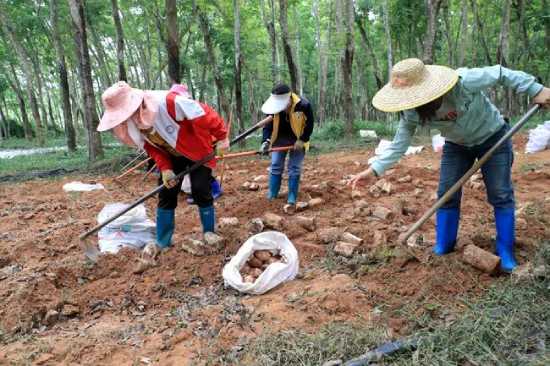
- The Perfect Shade: The crop is grown entirely under the dense canopy of local rubber forests, which provide a natural 70% shade rate—mimicking the exact deep-jungle lighting where wild Tiger Milk Mushroom thrives. Rubber forest understory is the most common cultivation model adopted across Hainan’s mushroom planting areas.
- Sandy, Well-Drained Soil: Unlike dense clay, the soil here features a “high-sand, low-dirt” composition. Combined with precise moisture control, this unique terroir prevents waterlogging while giving the fungal roots room to breathe. Such sandy soil is naturally distributed in northern Hainan’s Danzhou area.
- A 6-Month Maturity Cycle: Planted in October last year, these mushrooms underwent six months of rigorous, climate-tracked care to ensure maximum nutrient accumulation before harvest. Local temperature stays steadily between 22–27℃ throughout the planting cycle.
Behind the Scenes: How Do Experts Verify Quality?
If you are wondering, “How do I know my Tiger Milk Mushroom supplement wasn’t harvested too early?”, the strict protocol at the Danzhou base offers a perfect example of pharmaceutical-grade agricultural oversight.
Before a single mushroom was dug up, cultivation technical directors from Baisha Lishu Bio-Technology conducted strict on-site testing. They checked three critical factors:
- Strict Timing: Confirming the exact lifecycle duration had been reached.
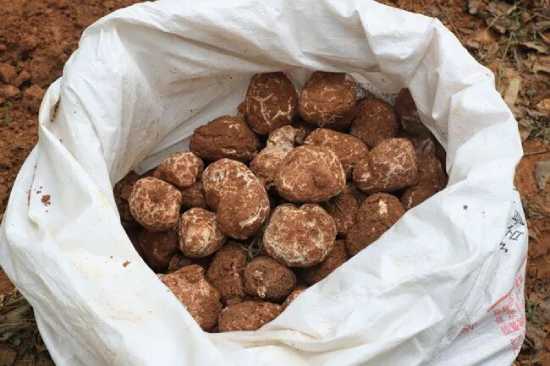
- Sclerotium Maturity: Verifying that the sclerotium (the nutrient-dense underground tuber used in medicine) was fully formed and packed with active bio-compounds.
- Nutrient Depletion: Ensuring the initial cultivation pouch’s nutrients were entirely consumed and converted into the mushroom itself.
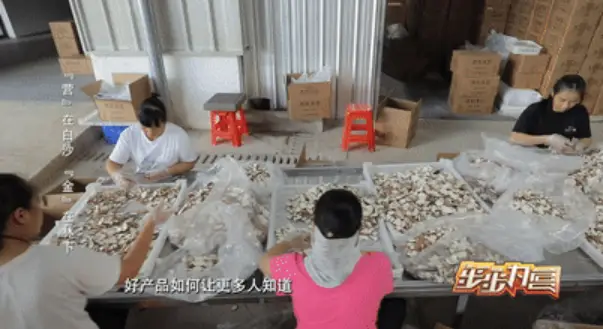
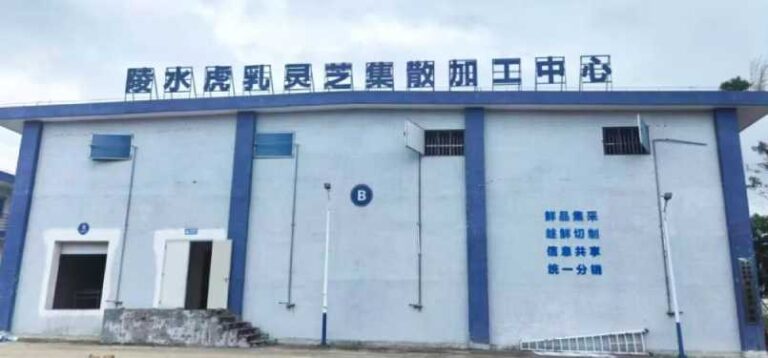
Only after passing these three checks were local workers permitted to carefully unearth the fungi, pack them, and transport them for pristine processing. All raw materials are transferred to nearby low-temperature drying workshops to reduce active ingredient loss.
Commonly Asked Questions by Mushroom Seekers:
“Why is the partnership between local farmers and tech companies important for consumers?”
When you ask “Where can I buy traceable and safe Tiger Milk Mushroom?”, look for structural partnerships. In this region, farmers are backed by technical guidance and protective buy-back agreements with specialized bio-tech firms. This means farmers focus strictly on quality and purity without cutting corners, delivering a pristine product to the global market. This farmer-enterprise cooperation model is widely promoted across Hainan’s medicinal mushroom industry.
“What happens to the soil after a Tiger Milk Mushroom harvest?”
Sustainability matters. After the current May harvest wraps up, the soil undergoes a intensive remediation and conditioning phase. This allows the land to rest and replenish its natural microbial balance before the next batch is planted in July, ensuring long-term eco-sustainability. No chemical fertilizers are applied during soil restoration.
The Takeaway
When choosing a supplement to support your immune system or respiratory health, remember that the best results come from transparent chains. The bustling May harvest in Danzhou proves that when scientific tracking meets a flawless natural environment, the resulting “Forest Gold” delivers the premium, reliable potency your body deserves.
How is Tiger Milk Mushroom cultivated and harvested sustainably?
“Forest Gold” Welcomes a Bountiful Harvest! Busy Harvesting Underway at the 30-Mu Tiger’s Milk Reishi Mushroom Farm in Xipei Community, Dacheng Town
News from the Danzhou City Converged Media Center: In May, the tiger’s milk reishi mushroom farm in Xipei Community, Dacheng Town, Danzhou City, entered its harvest season. “We’ve been busy harvesting these past few days. Once this batch is harvested, we’ll prepare the land and plant the next batch of tiger’s milk reishi mushrooms in July,” Chen Shiding, Secretary of Xipei Community, told reporters.
Tiger’s Milk Ganoderma is a rare edible and medicinal mushroom rich in active components such as polysaccharides and terpenoids. It possesses antioxidant properties and helps boost immunity, earning it the title of “Forest Gold.” It boasts broad market prospects and immense potential for industrial development.
Currently, the tiger milk ganoderma cultivation base in Xipei Community spans 30 mu. Planting began last October, and after six months of meticulous care, the crops have now fully entered the harvesting phase. On the 8th, a reporter observed at the base that under the lush rubber tree canopy, 10 workers were digging the thriving Ganoderma lucidum from the soil. After placing them in collection bags and packaging them, the harvest was transported en masse to Baisha County.
“The Xipeiju Tiger Milk Reishi base leverages the area’s abundant rubber plantation resources. In particular, the soil is sandy with minimal clay content, and the shade coverage reaches 70%, creating an ideal growing environment for Tiger Milk Reishi. As a result, the base’s Tiger Milk Reishi industry has developed rapidly and is now enjoying a bumper harvest.” Chen Shiding explained that in addition to this base, many villages in Dacheng Town have also begun cultivating tiger’s milk ganoderma in recent years. As long as sufficient water is ensured, the region’s resource advantages can be fully leveraged, and the returns from growing tiger’s milk ganoderma are quite favorable. Furthermore, during the cultivation process, Baisha Lishu Biotechnology Co., Ltd. provides mushroom spawn bags and technical guidance, and signs minimum-price purchase agreements with growers. Consequently, after careful consideration, many growers have decided to invest in cultivation, leading to rapid development of the Tiger’s Milk Ganoderma industry.
“Before planting, we conduct on-site inspections of soil and water conditions. We also provide enhanced follow-up services during the cultivation process. If growers encounter technical or management issues, we visit them on-site to help resolve the problems,” said Li Xuejun, Director of Cultivation Technology at Baisha Lishu Biotechnology Co., Ltd. He explained that before harvesting this batch of Tiger’s Milk Reishi at the Xipeiju base, they visited the site to confirm that the cultivation period had elapsed, the sclerotia were fully mature, and the mycelium bags had exhausted their nutrients—only then was harvesting permitted.
During the interview, Chen Shiding ran the numbers for the reporter: Each mu of land can accommodate 3,000 cultivation bags for tiger’s milk ganoderma. Based on current harvest yields, each mu produces 1,200 jin of fresh product. With a purchase price of 20 yuan per jin, the output value per mu reaches 24,000 yuan. After deducting costs, the net profit per mu is approximately 7,000 yuan, representing a highly substantial return.
It is reported that during the harvesting season at the base, local villagers also participate, earning 150 yuan per person per day. At the same time, many villagers and village officials have come to learn about the cultivation and profit potential, expressing their willingness to join the cultivation effort.
“There is a vacant plot not far from the base, and I plan to plant tiger’s milk ganoderma there in the second half of the year. Furthermore, after seeing the tangible results, many people have expressed their desire to join the tiger’s milk ganoderma cultivation industry. I believe that in the near future, our tiger’s milk ganoderma industry will develop rapidly and grow larger and larger, and the villagers’ lives will continue to improve,” said Chen Shiding. (By Lin Xiaoyun, Danzhou City Converged Media Center)